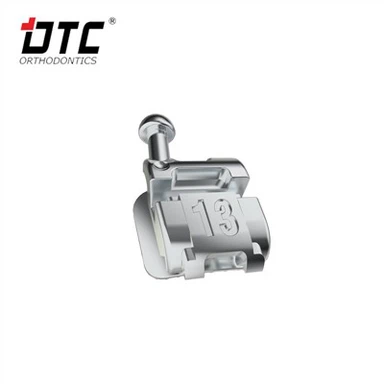
Classification Of Metal Brackets
Feb 18, 2022
(1) Precious metal brackets
In the early development of brackets (early 20th century), most of them were made of precious metals. Because precious metals have good processing properties, they are suitable for manual processing techniques at that time. And it has better corrosion resistance, but its shortcomings are also obvious, such as poor mechanical properties such as hardness, easy deformation, and expensive. The precious metals used mainly include gold, gold alloys, nickel silver alloys, etc. The first and second generation square wire brackets are made of precious metals.
(2) Stainless steel brackets
With the development of metallurgical industry and machinery industry, stainless steel materials are gradually used in bracket series. The third-generation square wire arch brackets that began in the 1940s have begun to use stainless steel. Especially after the Second World War, stainless steel quickly replaced precious metals and became the mainstream of fixed orthodontic materials with its excellent mechanical properties (such as higher hardness, lower wire groove friction resistance and low price, etc.). To this day, stainless steel brackets are still the most widely used brackets for fixed orthodontics. In addition, because stainless steel contains a certain composition of nickel, it is not suitable for people who are allergic to nickel. According to data, about 11.1% of women and 2.2% of men have a definite allergic reaction to nickel.
(3) Pure titanium bracket
In order to overcome the sensitization of nickel in stainless steel brackets, it was proposed to use pure titanium brackets. Pure titanium brackets are light in weight, have good biocompatibility and corrosion resistance. The friction coefficient of the wire groove is equivalent to that of the stainless steel bracket. However, because titanium metal is expensive and has no obvious improvement in appearance, there are not many users of titanium brackets.
(4) Magnetic bracket
In developed countries, magnetic brackets are also used. This kind of brackets are made of magnetic materials containing 30% Sm and 70% Co, which can control the mesial and distal movement of the teeth through the magnetizing direction of the brackets.