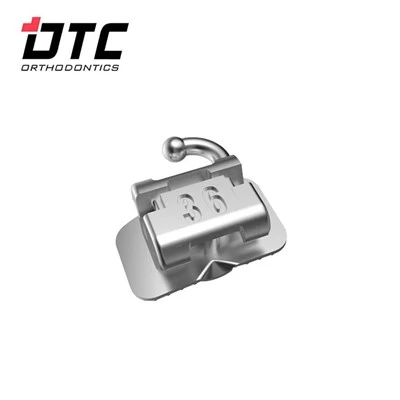
Orthodontics - self-ligating bracket correction process
Nov 11, 2023
Mainly divided into two categories: metals and ceramics. It is more recommended to choose metal ones, because the cost of ceramic brackets is higher than that of metal brackets, except for the added aesthetics.
The experience itself is not much different, and the grooves of ceramic brackets may not be as smooth as metal brackets, and there is a risk of being fragile.
For doctors, since the color is similar to the teeth, it will be more troublesome to position the brackets and the positioning may be inaccurate.
In addition, there are currently some customized brackets, which are not as cost-effective as invisible braces.
Depending on the plan, tooth extraction or bone nailing may be required at the beginning or in the middle of the correction. It is best to have bone nails inserted by your attending doctor.
The first and most important step in bracket correction is the bonding of the brackets.
Orthodontic brackets are generally fixed on the teeth through special adhesives. The bonding is divided into direct bonding and indirect bonding.
1. Direct bonding method
(1) Visually determine the clinical crown center of each tooth. During acid treatment, only the partial enamel of the crown is decalcified;
(2) Align the center of the brackets with the center of the clinical crown, and the position of the incisor brackets can be slightly aligned with the medical | education network;
(3) Adjust the vertical mark line in the center of the bracket to coincide with the long axis of the clinical crown of the tooth. The bracket is located in the middle of the mesio-distal part of the labial and buccal surface of the crown.
2. Indirect bonding method
By determining the position of the bracket on the tooth model and then transferring it to the patient's mouth, clinical work becomes extremely easy.
At the same time, it can also ensure the accurate positioning of the brackets. This method of bonding the brackets through indirect means is called indirect bonding technology.
At present, direct bonding technology is mainly used. The positioning of the brackets during bonding is extremely important and requires the attending physician to operate.
After the bracket bonding is completed, the next step is the alignment and leveling stage of traditional correction. The main process is to change the wire, which has little technical content.
The main thing to pay attention to in this process is to twist or align the teeth outside the arch, and to release the lock.
If there is a deep overbite, it may be necessary to align the upper dental arch first and then perform jaw alignment before starting to align the lower teeth.
Patients with underbite may have their lower teeth aligned first and then their upper teeth.
Let me digress here. If the brackets fall off in the early stage, don’t worry too much, because the arch wires of the braces are thin wires.
If the brackets fall off, your normal life will not be affected and you can wait for the follow-up appointment to stick them together;
It was later replaced with thicker silk, which tightened the seams so hard that if it fell off, it would have to be glued to the hospital in time.
In addition, in some hospitals, the doctor's assistant and the doctor glue the brackets together. You will find that the doctor's glue does not fall off, but the assistant's glue only falls off several times a week. Therefore, the brackets are old and worn, and it is very likely that the doctor did not glue them on you properly. oh.
There are also some other situations, improper care, problems with the teeth themselves, or rough workmanship at the bottom of individual brackets.
It may cause the brackets to fall out, and blindly doubt the doctor, causing tension between the doctor and the patient.
Don’t be nervous if you accidentally swallow the brackets. The brackets are very small and can be excreted by eating more vegetables to supplement vitamins.
All in all, if the treatment starts at the same time, the process will take about half a year if everything goes well.
If it is done step by step, it will take about a year, and the follow-up interval will be about one month to one and a half months.
At this stage, it is necessary to achieve the neatness of the dental arch arc and the straightness of the front and rear spee curve. Sometimes the front teeth will have gaps, which is generally a normal phenomenon.
After alignment, the top and bottom will be switched to the last wire and the jaw pad will no longer be worn. According to the condition of the dental arch at this time, the wire must be adjusted accordingly, which is another critical step.
The usual adjustments are rocker, torque and bow. Sometimes a CT scan will be taken to determine how to adjust.
After threading, the seam is closed or the whole seam is retracted according to the plan. The duration is variable.
This stage is the stage of adjusting the sagittal occlusal relationship. The operation of applying force is relatively simple, but how to apply force requires regular monitoring by the attending doctor.
Generally, the patient will be checked at least every three months, with additional follow-up visits once a month.
If the correction is performed in another place, you can sometimes hang the rubber band yourself to reduce the number of follow-up visits.
After the teeth have no gaps and are in place, the bite begins to be finely adjusted. At this time, the main adjustments are vertical or horizontal.
Lateral adjustments are best started in the late stages of afterburner. This stage mainly assists with various tractions and adjusts the occlusion of the teeth to achieve stable release. The adjustment design is relatively complicated and needs to be reviewed by the doctor in person. The process mainly relies on hanging rubber bands by oneself. Sometimes the doctor also needs to adjust the main arch wire again, usually one month One follow-up visit.
Finally, I would like to emphasize again that no one has noticed that orthodontics actually pays more attention to the technical level, qualifications and experience of the doctor than to the braces.
Don’t ignore this. If the teeth are not moved properly, the bite will become bad.
It is possible to cause excessive root resorption or alveolar bone destruction. In more serious cases, even secondary correction cannot be performed.
So friends, don’t worry about which braces to use, do your homework as a doctor first.
With a good doctor, we don’t need to pay attention to the above steps in detail to see whether the operation is standardized. You just need to cooperate well, listen to the doctor’s words, and your teeth will be successful.
So what makes a good dentist? Are the dentists that are popular on the Internet really reliable? Is it necessary for a doctor to have a master's degree in orthodontics or above?
Doctors with a master's degree in orthodontics or above are currently employed in first- and second-tier cities. However, our orthodontic population is very broad, and doctors with high qualifications are not yet covered in most prefecture-level cities. In order to cover more people For the orthodontic population, professional training for orthodontists will be carried out with the support of many policies.