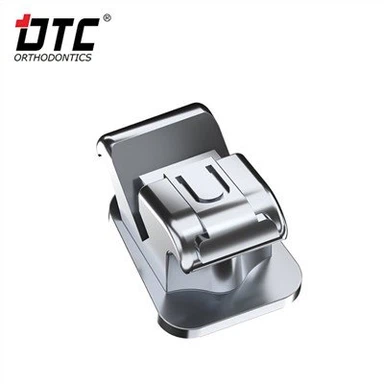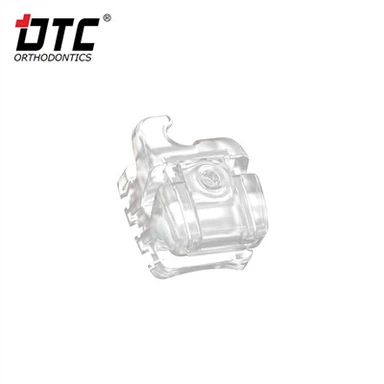


Orthodontic Lingual Bracket
The orthodontic Lingual Bracket: was designed and created from an idea in 2006 after the first WSLO meeting. Then developed after bonding thousands of lingual brackets in a precise lab environment which had the capacity to measure angles and thicknesses.
- Fast Delievery
- Quality Assurance
- 24/7 Customer Service
Product Introduction
The following is Professor Peter's self-report on this orthodontic Lingual Bracket:
The orthodontic Lingual Bracket: was designed and created from an idea in 2006 after the first WSLO meeting. Then developed after bonding thousands of lingual brackets in a precise lab environment which had the capacity to measure angles and thicknesses. Also through discussing with experienced Dr’s what they consider essential features for a lingual bracket and attending countless meetings around the world on the subject of 'Lingual Orthodontics'.
Comfort for the patient is an essential factor. This is achieved by the angle of the base to slot and the smooth contouring of the shape to allow the bracket to lie as close to the lingual surface as possible, but there’s no point making a small thin bracket if we have to use lots of resin to make it fit. Also handling and function are very important to the Orthodontist!
So brackets need to be functional for the Dr’s to use varying techniques. The Orthodontic Lingual Bracket bracket has large single tie wings, rather than double ones, that can be used for chains and in modules or SS ligations should the need arise. Partial ligation with elastic modules and the doors open is a possibility with these brackets. By having a nicely contoured single wing, the patients will tongue adapt more quickly and reduce the chance of sore spots from small pointed surfaces. It should also be easier to clean.
The bracket slot angle for the Upper anteriors of 60 degrees was to enable the base to get much closer to the gingival third of the average teeth. This keeps the composite pads to a minimum. The lower is 45 degrees.
The NEW slot size of 017 x 025 is to keep the forces light, but without sacrificing torque control! Torque control is the weakness of most brackets systems, be them lingual or labial. This slot size combined with the passive self-ligating mechanism gives a perfect blend of very light friction on a Stainless Steel 016 x 022 wire, whilst providing excellent torque control, minimizing the play when moving teeth.
The 'Guillotine' latch mechanism designed by Peter in 2006 is easy to open and close allowing quick wire changes and reducing clinic time. No special tools are needed!
The latch is smaller than the slot width, so early on in the treatment, the wires are easier to engage allowing them to be threaded around the malocclusion.
Because the latches are inside the bracket body, so the resistance to retraction forces is better than an external clip which can become disengaged during certain stages of the treatment. As the latch can only ever have a 3 point contact with a full sized wire, absolute torque and in –out expression is established, but with again less friction than an active clip.
The sliding latch will help push the last wire fully into the slot as it is closed due to the angle of closure v’s the wires edge.
The Nickel Free, N17 Stainless Steel body is made through MIM technology for precision and a standard and time tested mesh / base is being used. This is laser welded to the body for strength and biocompatibility.
Each set contains only 5 different brackets, thus reducing inventories and allowing exchanges. All 6 upper anterior brackets are the same and so are the lowers. All premolars are the same in upper and lower and also the molars, except the molars have a hook at the mesial so therefore we have left and right options.
Tubes are an option for the last molars, but it is perfectly possible to use extra SL molar brackets instead making it easier to thread the wires through, so arch wire insertion is simplified.
Each anterior bracket can be identified by a coloured spot and a U for the uppers and a L for lowers.
Lastly the price for a Lingual SL bracket is usually high and we are trying to make Lingual more popular by offering Innovation at low cost!

Summary:
Orthodontic Lingual Bracket
-The slot /base angle is different to get a closer fit of the bracket to the Lingual Gingival third of the morphology, thus making the traditional composite pads thinner. This should also increase patient tolerance.
-The slot size is smaller, so therefore smaller wires will be used, making the forces transmitted to the teeth lighter and wires easier to insert.
-The SL door is inside the bracket body creating a 4th wall and therefore closing the wires inside against all possible forces that would displace an o-ring elastic ligature or or possibly open a SL clip. So no problem for rotation forces and retraction forces! But still with low friction, unlike the normal elastic ligations which create high friction and poor wire retention in crowding cases.

OME
We offer OEM service for different clients.
1. Can Sandblasting: improve the bonding 15%
2. Identification: make number mark
3. Different plastic boxes and card packages for option
4. Label customized

Opening And Closing Of The Slider
The passive opening of the slider ensures the comvenience of placing and removing archwires.
The easy "spin-and-open" technique replaces the traditional‘ pul-and-open technique, therefore patient enjoys the painfree orthodontic treatment by less traction force applied to the teeth.
★ Can shorten the treatment process (low friction moving fast).
* Extend the time between follow-up visits.
* No need to ligature, comfortable.
* Hygienic, easy to clean.
Round Corner let patient feel comfortable & Round edge and smooth wing, won't hurt gingival tssue.
Hard stainless steel ensure stable performance.
80# mesh base: more fitness to the tooth.
Accuracy slotfor lower friction.
Hot Tags: orthodontic lingual bracket, China, manufacturers, factory, customized, wholesale, buy, price list, Lingual Eyelets, Lingual Self ligating Bracket, ORG Lingual, Orthodontic Instrument